1. What is Personal Branding? And How to Start Building Your Personal Brand
Ask ten people to define personal branding and you will get ten different answers. Some will say it's your social media presence. Some will say it's your logo, your colours, your headshot. Others will mention consistency, or storytelling, or thought leadership.
All of those things can be part of a personal brand. But none of them are the brand itself.
So let's go back to basics.
If I had to define personal branding in a single word, that word would be: reputation.
Your personal brand is what people say about you when you're not in the room. It's the impression you leave behind after every conversation, every post, every proposal, every interaction. Whether you have intentionally built a personal brand or not, you already have one. The only question is whether you're managing it — or leaving it to chance.
“Personal Branding is the Art of intentionally and proactively managing your reputation.”
That word — intentionally — is where everything changes.
Most experts spend years building their expertise but very little time thinking about how that expertise is communicated to the outside world. The result is a gap: a credibility gap between the quality of what they do and how they're perceived by the people they most want to reach.
This article is about closing that gap. It's a foundational guide to what personal branding actually means, what an authentic personal brand looks like (and why it performs better than any fake, perfectly curated one), and a practical framework for how to start building yours.
What Personal Branding Actually Is — and What It Is Not
Let's clear up the most common misconceptions first.
Personal branding is not self-promotion. It is not about broadcasting how great you are or performing a carefully curated version of yourself online. It is not a logo, a colour palette, or a catchy tagline. And it is definitely not the same as having a lot of followers.
Personal branding is the deliberate management of how your expertise, values, and personality are perceived by the people who matter most to your work, the ones you CAN help.
It's what allows someone to understand, quickly, who you are, what you stand for, and whether they can trust you, even before they ever speak to you.
Think about the brands you buy from without hesitation, the ones you reach for when something really matters. You choose them because you trust them. The promise has been made and kept, consistently, over time. Your personal brand works exactly the same way.
In a business context, your personal brand is the answer to the question: "Why you?" Not your company, but you, as the person behind the expertise.
And in an era where buyers can have all the information they need to know even before they contact anyone, your digital presence is not a nice-to-have, it is a MUST.
The Difference Between a Real Personal Brand and a Fake One
Here is the tension that defines personal branding right now.
On one side, we have more tools than ever to look polished, professional, and impressive online.
AI can write our posts. Filters can smooth our photos. AI can create perfect photos. Templates can make anyone look like a thought leader. The result? A content landscape full of people who all sound the same, look the same, and say the same things, beautifully packaged and utterly forgettable.
I believe that the average piece of content has improved in quality, which means that content that can be produced with AI has become a commodity.
On the other side, we have audiences that are increasingly sceptical, increasingly discerning, and increasingly hungry for something real.
The personal brands that break through are not the most polished ones. They are the most authentic ones.
There is a concept I keep coming back to, and it comes from Japan.
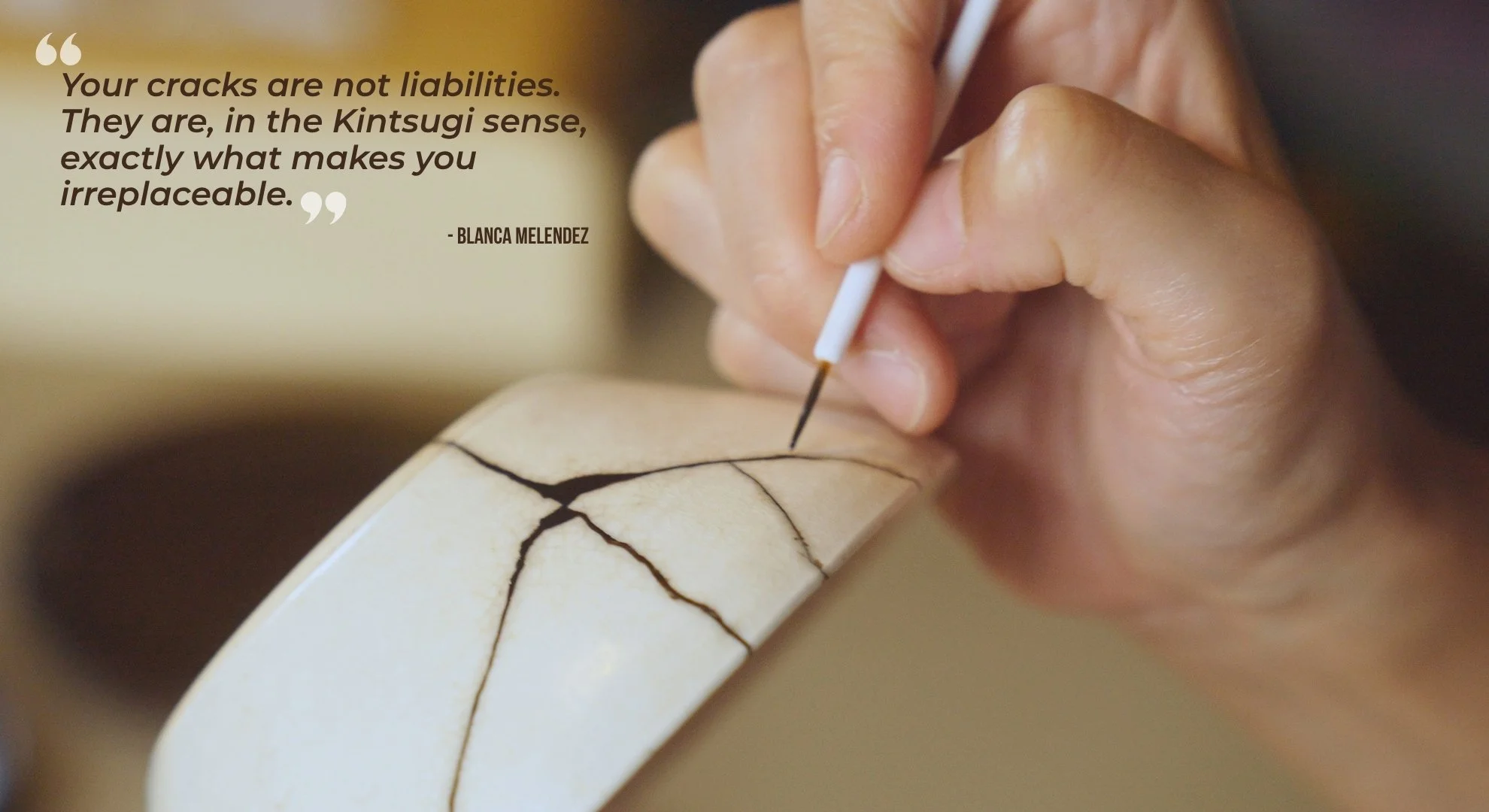
It's called Kintsugi — the art of repairing broken pottery with a mix of lacquer gold, silver or platinum. Instead of hiding the cracks, they are filled with this mix, making them the most visible and beautiful part of the piece. The philosophy behind it is profound: the history and imperfection of an object is part of its value, not something to be concealed.
I think about this a lot when I work with clients on their personal brands.
The experts who have the most powerful, compelling brands are not the ones who present a flawless surface.
They are the ones who are willing to let their lived experience: including the detours, the pivots, the mistakes, the struggles and the moments of doubt, become part of their story.
Not because vulnerability is a strategy, but because it is what makes a human being relatable, believable, and trustworthy.
An authentic personal brand doesn't mean sharing everything. It means sharing honestly. It means letting your specific perspective, shaped by your specific experience, come through in everything you do — your content, your photography, your conversations, your positioning. It means building a brand that is unmistakably you, because that is the only one that AI cannot replicate and competitors cannot copy.
“Your cracks are not liabilities. They are, in the Kintsugi sense, exactly what makes you irreplaceable.”
Who Actually Needs a Personal Brand?
Here is a myth I want to address: building a personal branding is not just for people starting out, for influencers, or for those who want to be famous online.
In fact, the experts who most need a strategic personal brand are often the ones who have been in business the longest.
I see it constantly. A consultant with 20 years of experience and a track record that speaks for itself but only within a certain network, with a LinkedIn profile that hasn't been touched in three years, and no clear articulation of what makes their approach different.
A successful founder whose business is growing, but who still feels like a well-kept secret. A coach whose clients get transformative results, but who struggles to consistently attract new ones at the rates they deserve.
What they share is not a lack of expertise. It's a gap between the quality of their work and how that work is perceived by the outside world. Their reputation exists, it's just not being managed. Not proactively, not intentionally, and not at scale.
That is what personal branding coaching and strategic positioning work is designed not to manufacture an image, but to ensure that the image people see actually matches the reality of what you deliver.
Related reading: Blog 80 — The Power of Personal Branding for Business Leaders

How to Start Building Your Personal Brand: The 3-Dimension Model
Over years of working with established experts, founders, and consultants, I developed the 3-Dimension Model — the strategic framework at the heart of everything we do at PeopleBrands.
Most approaches to personal brand building focus on tactics: what to post, how often, which platform. The 3-Dimension Model is different. It works from the inside out, because a personal brand without a strategic foundation is just noise — however beautifully packaged.
Here is how each dimension works:
Dimension 1: Strategic Positioning — Know Who You Are Before You Communicate
Before you create a single post, book a photoshoot, or redesign your website, you need to answer a foundational question: Who are you in the market, and why does it matter?
Strategic positioning is the dimension most people skip — and the reason most personal branding efforts fail to gain traction.
The sequence I take every client through is: Know yourself → Know your client → Then communicate. Not the other way around.
Knowing yourself means getting genuinely clear on your values, your strengths, your unique perspective — the things that have been shaped by your specific journey, including the parts that were hard.
This is the Kintsugi principle applied to strategy: your path, with all its detours and recoveries, is what gives your positioning its depth and credibility.
Knowing your client means understanding not just their demographics but their inner world — what keeps them up at night, how they describe their own problems, what they've tried before. It means meeting them where they are, not where you assume they should be.
Only then does communication — content, messaging, positioning statements — actually land. When you've done the inner work first, everything you say has direction and resonance. Premium clients start to self-select, because they can see clearly why you are exactly the right person for them.
“You cannot build a strong personal brand on a shaky foundation. Self-awareness must come before visibility.”
Dimension 2: Visual Identity of the Future — Align with the Brand You're Becoming
This is the dimension that most people think personal branding is entirely about — and they are missing the bigger picture.
Yes, professional personal branding photography, video, and branded assets matter enormously. But not for the reason most people think.
In my TEDx talk at TEDx Nuremberg 2025 — "Hack Your Brain: Turn Your Dreams to Reality with Visual Identity" — I explored the deeper psychology behind why visuals are so powerful in personal brand building. And it goes far beyond looking impressive online.
Visuals are not just about how others see you. They are about how you see yourself.
There is a concept in behavioural psychology called identity-based change: when you begin to see yourself as the person you are becoming, you start to act like that person.
Your brain cannot fully distinguish between a vividly held vision of the future and the present — and visual identity is one of the most powerful tools we have to close that gap.
This is why I always say: your visual identity should represent the future version of you, not just the one you are today.
When I work with clients on their personal brand photography or video, we are not just capturing where they are now. We are building the visual identity of who they are becoming — the authority, the thought leader, the go-to expert in their field. The result? Stronger photos, yes. But more importantly, a shift in how they show up: in client conversations, in the rates they charge, in the opportunities they say yes to.
Explore this further: Blog 79 — From Vision to Reality: How Personal Branding Visuals Shape Your Identity
Dimension 3: Thought Leadership Content with a System — Show Up Consistently in Your Own Voice
You have done the strategic work. You have a visual identity that reflects your expertise. Now comes the part that most experts find most daunting: showing up consistently, in public, with something worth saying.
Visibility without a system is just noise. And a thought leadership strategy built entirely on AI-generated content will never build the kind of trust that opens real doors, because it cannot carry your actual perspective, your real experience, or your genuine voice.
This is why I developed the I.A.M. Framework as the content engine for this third dimension. I.A.M. stands for:
Insight — Your expertise, frameworks, and knowledge that prove you know your field.
Authenticity — Your humanity, your journey, the honest moments that make you relatable and trustworthy.
Mission — Your purpose beyond the business — what you believe in, what you stand for, why it matters.
The I.A.M. Framework is my proprietary content strategy for established experts. Unlike generic content advice that focuses on tactics (post types, frequency, which platform), I.A.M. focuses on strategic identity — ensuring you are consistently seen for your expertise, your humanity, and your purpose. All three together is what transforms a knowledgeable professional into a recognised authority.
In practice, this plays out across every platform where your ideal clients spend time and for most established experts, that means LinkedIn is non-negotiable.
Personal branding on LinkedIn is not about posting every day. It is about showing up strategically: a well-optimised profile that communicates your value proposition immediately, long-form content that demonstrates your depth of thinking, and a consistent presence that builds familiarity and trust over time. When someone Googles you or lands on your profile before a meeting, what they find is either building your case or weakening it. There is no neutral ground.
Related: Blog 77 — Transform Your LinkedIn Profile: Essential Steps to a Powerful Personal Brand
Where to Actually Start
The most common mistake I see is jumping straight to tactics.
Investing in a personal brand photography shoot before clarifying your positioning. Redesigning a website before knowing what message it should send. Posting on LinkedIn every day before deciding what you actually stand for.
The result is always the same: a lot of effort, very little momentum.
The right starting point is always to start with clarity: look at where you currently stand: what's working, what's missing, and where the gap is between your expertise and how you're perceived. That's the foundation that makes everything else, the strategy, the visuals, the content, actually work.
My Personal Brand Visibility Scorecard is a good first step. It assesses your brand across 7 key dimensions — strategic positioning, visual identity, thought leadership, LinkedIn presence, and more — and shows you exactly where to focus first.

The Bottom Line
Personal branding is not about being everywhere. It is not about performing a version of yourself you think people want to see.
It is the art of managing your reputation intentionally — so that the impression you leave behind actually reflects the expertise you have built.
The most powerful personal brands are not built by hiding imperfections. They are built by the experts who are willing to let their real story — the full one, cracks and all — become the foundation of their authority. Just like Kintsugi, the gold is in the honesty.
Your story deserves to be told. Let's make sure the right people hear it.
Frequently Asked Questions
What is personal branding?
Personal branding is the art of intentionally and proactively managing your reputation. It is the deliberate process of shaping how your expertise, values, and personality are perceived by the people who matter most to your work — so that when your ideal clients, employers, or collaborators encounter you, they immediately understand who you are, what you stand for, and why you are the right person for them.
What is the difference between a personal brand and a company brand?
A company brand represents a business entity. A personal brand represents a person — their expertise, perspective, values, and story. For consultants, coaches, and founders, the two are often deeply connected: the personal brand of the founder or lead expert is frequently the most powerful trust signal a business has. People buy from people they trust, and personal brands create that trust faster and more deeply than any logo or tagline can.
How do I start building my personal brand on LinkedIn?
Start with your profile, not your content. Your LinkedIn profile is often the first place someone lands after hearing about you — it needs to communicate your value proposition immediately, not read like a CV. Make sure your headline speaks to who you help and what outcome you deliver. Your About section should tell your story, not list your job history. Only once your profile is doing its job should you focus on building a content strategy that demonstrates your expertise consistently over time.
Do I need professional personal branding photography?
Yes — and not just for vanity reasons. Professional personal branding photography is one of the most direct signals of credibility and investment in your own brand. When someone lands on your LinkedIn profile, your website, or your speaker page, the quality of your visuals communicates something before a single word is read. More importantly, the process of creating a visual identity that reflects who you are becoming — not just who you are today — has a measurable impact on how you show up in your business.
What is authentic personal branding?
Authentic personal branding is built on lived experience, including the struggles, pivots, and imperfections — not just the highlights. It is the opposite of a polished, manufactured image that looks impressive but feels generic. An authentic personal brand is distinctive because it is genuinely yours: your perspective, shaped by your specific path. In an AI era where generated content is everywhere, authenticity is the rarest and most valuable currency a personal brand can have.
How is personal branding different from marketing?
Marketing promotes what you sell. Personal branding communicates who you are. Personal branding is the foundation that makes marketing credible and effective. Without it, marketing often feels like an interruption. With it, your marketing starts to do the work before you even begin the conversation — because the people you want to reach already know, like, and trust you.
How long does it take to build a personal brand?
The strategic foundation — positioning, visual identity, and a content system — can be established in a matter of weeks. But a personal brand that genuinely opens doors is built over months and years of consistent, intentional presence. The experts who see the most significant results are those who commit to it as an ongoing practice, not a one-time project.

About Blanca
I'm Blanca Meléndez — Personal Brand Strategist, TEDx Speaker, and founder of People Brands.
I help established executives, founders, and consultants close the gap between their expertise and their visibility — through strategic positioning, visual identity, and thought leadership content.
With 10+ years in corporate (Siemens, Nestlé, Gates Foundation) and a Master's in Marketing from ESIC Business School, I understand both the corporate world and the journey of building a business around your expertise. That's what makes my approach different.
I speak on Personal Branding, Visual Identity, The Power of Reinvention, Entrepreneurship as an Expat, and Thought Leadership in the AI Era.