Blog 86: The 7 Dimensions of a Visible Personal Brand (And No, Famous Isn’t One of Them)
Let’s clear something up right away.
When most people hear the words “personal brand,” they immediately think: millions of followers, viral content, magazine covers, a global stage, in other words: BEING FAMOUS.
And while many personalities with massive followings, do have a very well-recognized Personal Brand…
…That’s not what this is about.
A personal brand doesn’t need to make you famous.
It needs to make you well known within your area of influence. What your area of influence is, is up to you to define it.
I was at a networking event, and one of the people I was talking to works in a very niche, specific area of technology. There are only three places for her in Europe: Munich, Netherlands or Stuttgart. Now, for someone like her, a huge following is not necessary, however, being well-known in her niche is a must.
For someone else having a global platform and a keynote stage in front of thousands might be the “right area of influence”.
Both are valid personal brands. Both require intentional, strategic work. And both start from the same foundation.
In my perspective, there are two kinds of established professionals who reach a point where they know their personal brand needs more visibility.
The first wants to be known and recognized within their sphere of influence, respected by the right people, staying top of mind in their niche, known within the circles where their ideal clients and collaborators move. Their goal is focused and intentional.
The second wants to grow beyond that, they want to build broader recognition, attract media attention, land keynote stages, and become THE name in their space.
Those are two different goals, at a different scale, but the same 7 dimensions make both possible. The only variable is how far you choose to take each one.
And here’s what I’ve observed working with established experts, coaches, consultants, and founders: most people are strong in one or two of these dimensions and largely invisible in the rest. That’s not a character flaw. It’s a visibility gap and visibility gaps can be fixed, once you can see them clearly.
Let me take you through all seven.
What I call the peoplebrands Visibility Ecosystem:
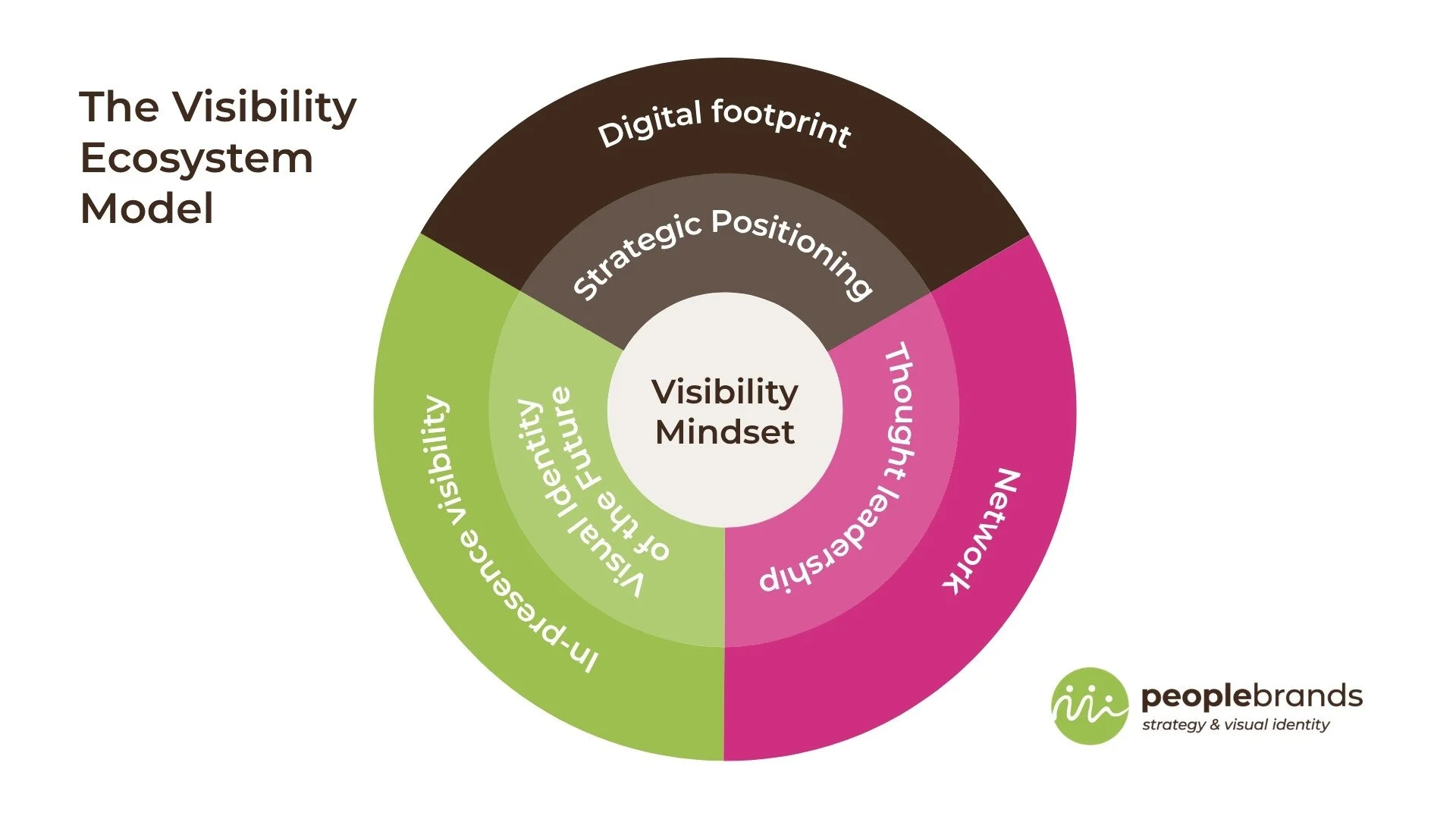
Dimension 1: Visibility Mindset
Are you genuinely ready to be seen or is something quietly holding you back?
This is the only internal dimension on this list. And it comes first, because nothing else works without it.
I’ve worked with brilliant people: consultants with 25 years of expertise, founders who’ve built companies from nothing, coaches with truly transformational methodologies, and yet, they weren’t fully ready to be seen.
The thought of putting themselves out there: to be visible, felt uncomfortable in a way they couldn’t quite name.
I can’t tell you how many times I have heard phrases like: “My work should speak for itself.” “I don’t need to be in the spotlight.” or some statement along those lines.
These aren’t just excuses. Brené Brown has spent decades researching exactly this: showing up and being seen, allowing yourself to be really seen is one of the most courageous things we do.
Here’s the tricky part, the higher your expertise is, the higher the perceived stakes are. Positioning yourself as THE expert, triggers the fear of judgment on most of us and it becomes very real. We have something to lose… our reputation… or so we think.
But here’s what staying invisible is actually costing you: every month you remain small, someone with half your experience is getting the speaking invitation you deserve. The premium client who would have been perfect for you found someone more visible. The media opportunity, the board seat, the strategic partnership, all went to a name people already recognized.
Your visibility mindset is the foundation everything else is built on. Before you invest in photos, content, or strategy… ask yourself honestly: am I actually ready to be seen at the level I deserve?

THE FOUNDATION OF THE PERSONAL BRAND
The next three dimensions are what I call the foundation of a Personal Brand, only when we have worked through these, we have a solid basis to develop the Strategy and the Brand Message of the personal brand.
Dimension 2: Strategic Positioning
Do people instantly understand what makes you THE expert not just AN expert?
Positioning is the answer to the most important question in personal branding: “What do you want to be known for?” … it should answer the question: “Why you and not someone else?”
This is about being able to communicate CLEARLY so that your ideal client immediately understands your unique value and sees you as the only logical choice for their specific situation.
April Dunford, in “Obviously Awesome”, makes a compelling case for this: it’s not enough to be good. You need to be clearly and unmistakably positioned so the right people immediately say, “that’s exactly what I need.” The same principle applies to people.
Weak positioning sounds like: “I help businesses grow.” Or “I’m a leadership consultant.” Or “I work with executives.” These aren’t memorable, differentiated, or actionable. They don’t tell me why YOU, why NOW, and why NOT someone else.
Strong positioning is specific, speaks to a real pain point, and immediately calls to the person it is intended to. It provokes a reaction: “That’s exactly what I’m dealing with.”
Without strategic positioning, everything else you build: your photos, your content, your LinkedIn presence, it is noise without direction.
Positioning is the strategy. It’s the first thing we work on in my S.H.I.N.E. Program before a single photo is taken or a single word is published.
Dimension 3: Visual Branding of the Future
Does your visual presence reflect where you’re going?
People form a judgment in seconds, whether we like it or not. Even before they read your bio, check your CV, or look at any of your content (if you even have any). They see you first. And what they see either confirms your authority or quietly undermines it.
What I often see is that there is a large gap between the level of experience, knowledge and talent from many professionals and the kind of digital presence they have… most often the Visual presence undermines their level.
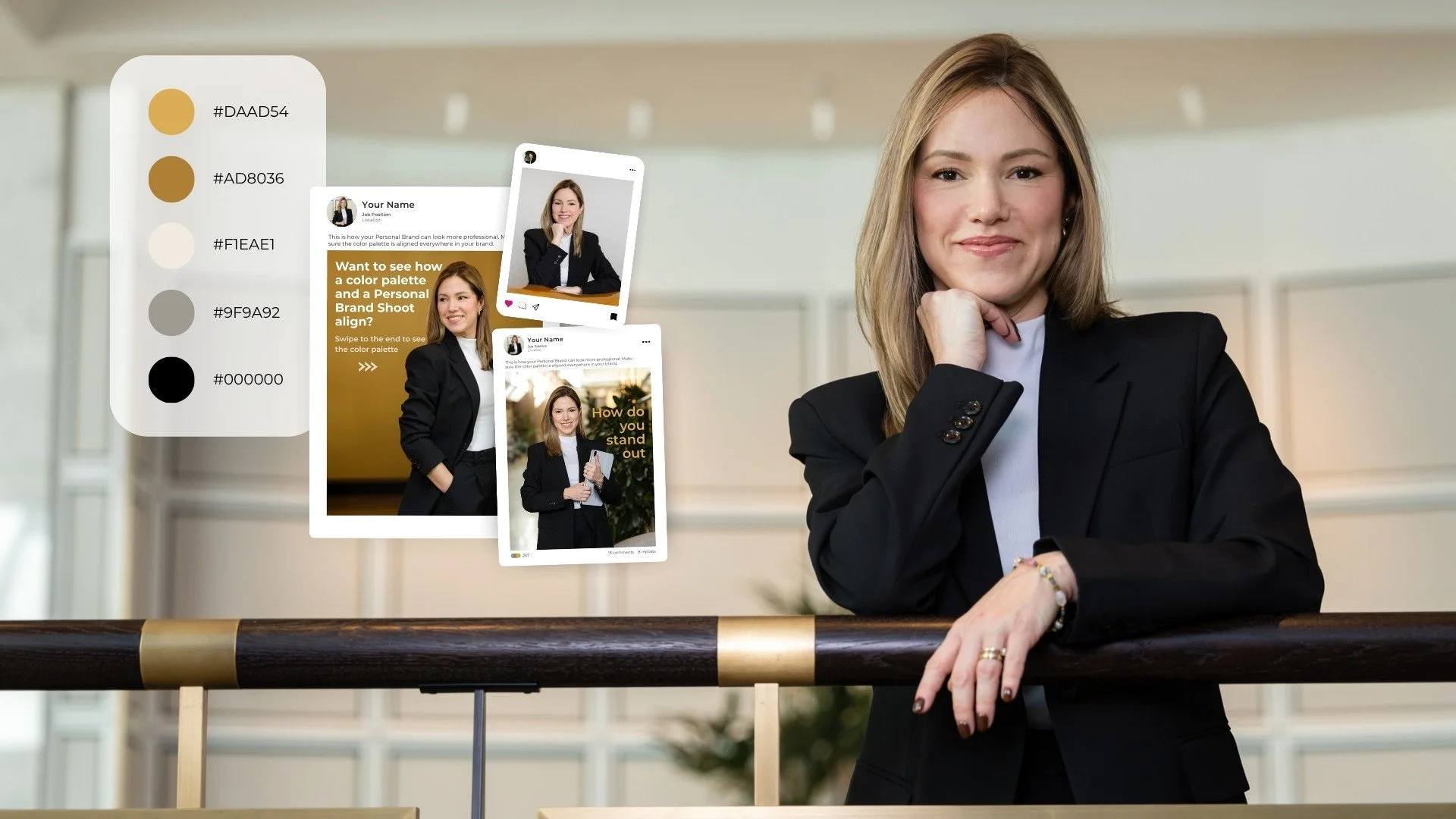
Your visual presence needs to be intentional, consistent, and aligned with the level of expertise you’re bringing to the table. Your photography, your color palette, your typography, your design across every platform they all send a signal before you say a word. The way you show up on video, the places where you show up.
Look at Mel Robbins. As a globally recognized speaker, bestselling author, and the host of the most shared podcast in the world, her visual brand is a masterclass in intentional consistency. Black, white, and a burst of yellow everywhere, always. Her typography, photography, social media posts, book covers: all speak the same visual language. You recognize her before you read her name. That’s not an accident. That’s strategy executed with discipline.
Now look at your LinkedIn banner, your profile photo, your website. Be honest: do they reflect where you are today and most importantly, do they reflect where you’re heading? Or are you still showing up with a headshot from a conference five years ago and a website that looked impressive when you built it in 2019?
Your visual brand should be a preview of where you’re going, not a postcard from where you’ve been.
It should reflect the expert you are, the one who deserves the stage, the premium client, and the recognition.
Dimension 4: Thought Leadership
Are you publishing ideas that make people think or staying quiet and hoping someone notices?
Thought Leadership is the dimension that sustains and amplifies all the others. It’s the ongoing proof of your expertise, it’s the proof that you have something to say worth listening to: the content, the frameworks, the perspectives that find people who haven’t found you yet, and deepen the trust of those who already have.
But here’s the distinction that most experts miss: thought leadership isn’t content. Read that again and let it sink.
Posting on LinkedIn three times a week is not thought leadership. Publishing your fifth article about “5 tips for better communication” is not thought leadership. Sharing other people’s insights without adding your own perspective is not thought leadership.
Thought leadership is the development and publication of your own intellectual property — your unique frameworks, your original methodologies, your proprietary way of seeing and solving a specific problem.
Platforms like LinkedIn are a tool, a medium of distribution of your ideas and thoughts, but posting randomly, without strategy is not thought leadership.
Daniel Priestley, in his book: “Key Person of Influence”, describes this with remarkable precision: a Key Person of Influence doesn’t just create content, they develop IP. They build structured thinking that is uniquely theirs and can be scaled beyond their time and presence. Your IP is what you become known for. It’s what people cite, reference, and share. It’s what gets you invited to speak, to write, to lead. It’s the difference between someone who shows up to share insights and someone who becomes the source of the insights others reference.
Oana Leonte, founder of UNMTCHD. and brand strategist with two decades at Disney, Warner Bros., and PUMA, frames this even more directly. In her work, she argues that content is not IP and the brands that scale to lasting influence are the ones that own something. Your IP is what compounds over time and creates value that transcends any single platform or algorithm. For an established expert, your thought leadership IP might be a proprietary framework, a unique methodology, a body of original research, or a distinctive point of view on your field that only you can hold because only you have lived your specific path.
The experts who become recognized authorities in their field are not the ones who post the most. They’re the ones who develop original thinking, publish it consistently, and build a body of work that belongs entirely to them.
What is your IP? What framework, methodology, or perspective do you own that could only have come from your specific 20+ years of experience?

Dimension 5: Online Visibility - your Digital Footprint
When someone searches your name on Google, LinkedIn, or inside an AI tool. Do they find an expert or a ghost?
Your online visibility is no longer just about what you post. It’s about what the internet and now, what AI knows about you.
Start with the basics: your LinkedIn profile, your website, your overall digital footprint.
When someone receives a referral and Googles your name, or when an event organizer looks you up after hearing you mentioned… What do they find? If the answer is an outdated LinkedIn profile, a website that hasn’t been touched in two years, and little more than that, your online presence is not doing the work it should be.
But in 2026, online visibility goes well beyond your own platforms and this is where it gets both more complex and more interesting.
Your ideal clients aren’t just typing into Google anymore. They’re asking ChatGPT, Perplexity, Gemini or Claude questions like: “Who are the best executive coaches?” or “What are the leading consultants in (fill your industry) in 2026?” If your name and your ideas aren’t being surfaced by those tools, you are invisible to an increasingly large portion of your potential audience.
Marketing experts like Neil Patel have written extensively about this shift: from traditional SEO to what’s now being called GEO (Generative Engine Optimization) and AEO (Answer Engine Optimization). In plain language: it’s not enough to rank on Google anymore. You need to be the source AI tools cite when someone asks a question in your area of expertise… I am jumping ahead, two words: Thought Leadership.
And here’s the insight that most people miss: being referenced by other sources matters just as much as what you publish yourself.
When podcasts feature you, when publications quote you, when other experts link back to your content, when event organizers list you as a speaker, when journalists name you as a source, all of that creates a web of credibility signals that both humans and AI recognize as authority.
Online visibility isn’t just about a well-crafted LinkedIn post or a beautiful website. It’s about becoming someone others reference, quote, and point to as the trusted source.
Ask yourself: when was the last time someone else mentioned your name or linked to your work in public?
That’s the kind of visibility that compounds over time and cannot be bought overnight.
Dimension 6: In-Person Visibility
Are you showing up where the decision-makers gather or are you only visible behind a screen?
Digital visibility is powerful. But there is something that happens in a room that no amount of LinkedIn posts can fully replicate.
Malcolm Gladwell, in his book: The Tipping Point, describes the remarkable influence of what he calls Connectors people whose relationships span multiple worlds and whose presence in a room creates a kind of gravitational pull. What Gladwell captures so well is that physical presence, being at the right table, having the right conversation face to face, being seen in the right rooms creates a type of trust and influence that scales far beyond the event itself.
Think about the last industry event you attended. Who got the most attention? Who left with the most meaningful conversations and follow-up meetings? In most cases, it was the person who spoke. The one who facilitated the workshop. The one who seemed to be naturally at the center of the interesting discussions.
In-person visibility means speaking at conferences, sitting on panels, hosting roundtables, participating in high-level masterminds, and being present at the events where the decision-makers in your field actually gather. These are the moments where trust is built at a speed that online connection cannot match. One meaningful conversation in the right room can open doors that six months of content creation couldn’t.
The question is: are you in the rooms that matter for where you want to go? And when you’re there, are you showing up as THE expert in the space or as just another attendee in the audience?
Dimension 7: Network Strength
Is your network growing and opening doors or are you moving in the same circles?
Network strength is not about how many people you know. It’s about whether the right people know you and think of you when the right opportunity appears.
Keith Ferrazzi, in Never Eat Alone, makes a distinction that I’ve found to be true both in my corporate career and in running my own business: the most powerful professional networks aren’t built through networking events and business card exchanges. They’re built through genuine relationships of mutual value where you invest in others not to extract something back, but because you believe in the collective. The relationships that open the biggest doors are the ones you built long before you needed them.
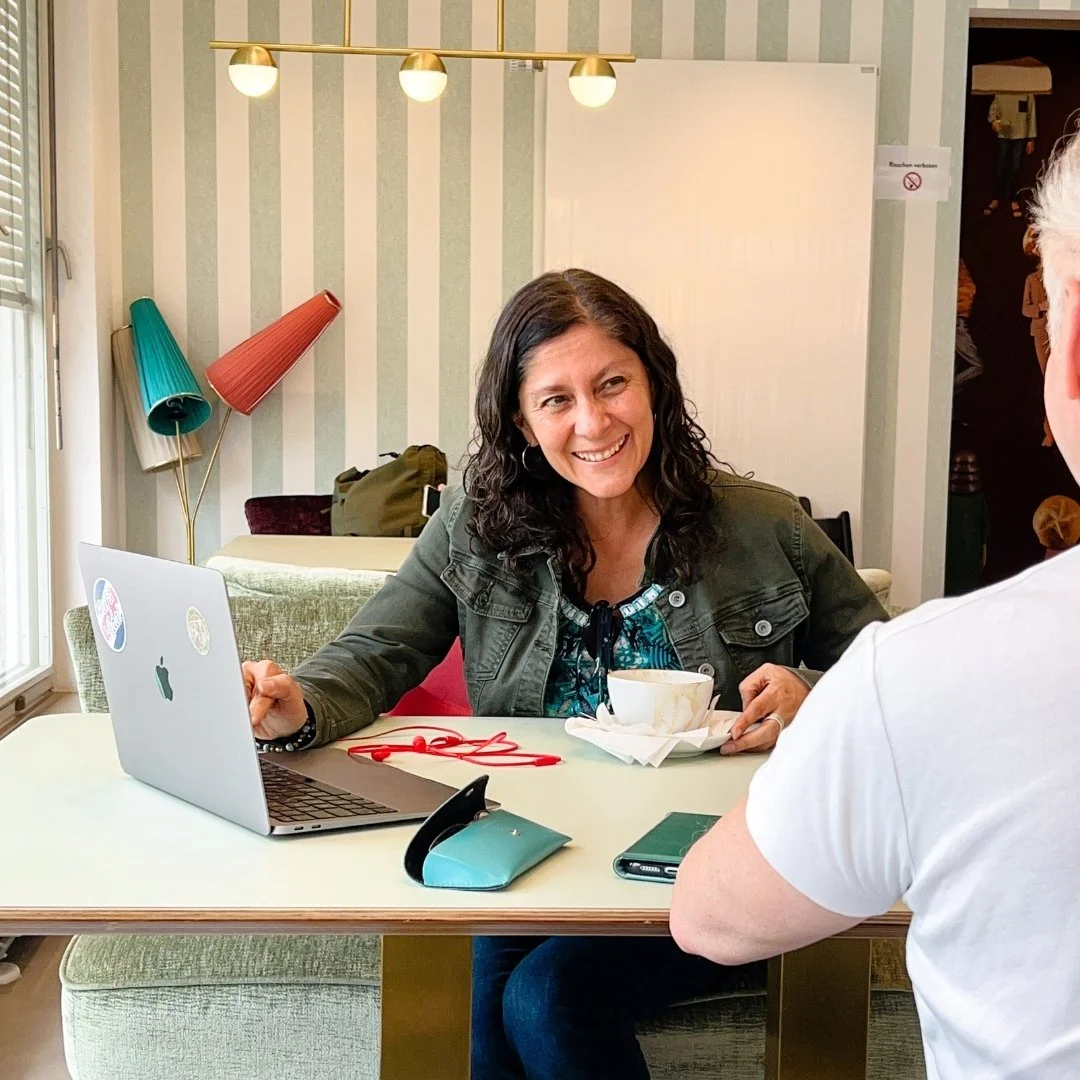
For an established expert, network strength means asking a harder question than “Do I know enough people?” The real questions are:
Do decision-makers in my field know my name and what I stand for?
When someone thinks of my area of expertise, am I the name they mention?
Are my connections opening doors I couldn’t knock on alone introductions to premium clients, speaking invitations, media features, strategic partnerships?
Or am I consistently talking to the same people, attending the same events, and circling the same familiar orbit?
Your network is either expanding your influence or containing it. There is very little middle ground.
Notice What’s Not on This List
Go back through all seven dimensions. Notice what isn’t there.
Millions of followers. Viral content. Press coverage in national publications. A TEDx talk viewed by a global audience. Being a household name.
None of that is required to have a powerful, visible personal brand. You don’t need fame. You need intentional strength across the dimensions that matter for your specific goals at whatever scale makes sense for your area of influence, your industry and your vision for your work.
What you do need is honest clarity about where you stand today. Most experts I work with are genuinely surprised when they do this audit. They’re strong in one or two dimensions and nearly invisible in the rest. They’ve been investing time and energy in the areas that feel comfortable while quietly neglecting the ones that would actually move the needle.
That’s exactly what the peoplebrands Visibility Ecosystem Scorecard is designed to show you.
Find Out Exactly Where You Stand Across All 7 Dimensions
The Personal Brand Visibility Scorecard takes 10 minutes. It measures your current positioning across all seven dimensions and gives you a clear, personalized picture of where your biggest gaps are — and where to focus first for maximum impact.
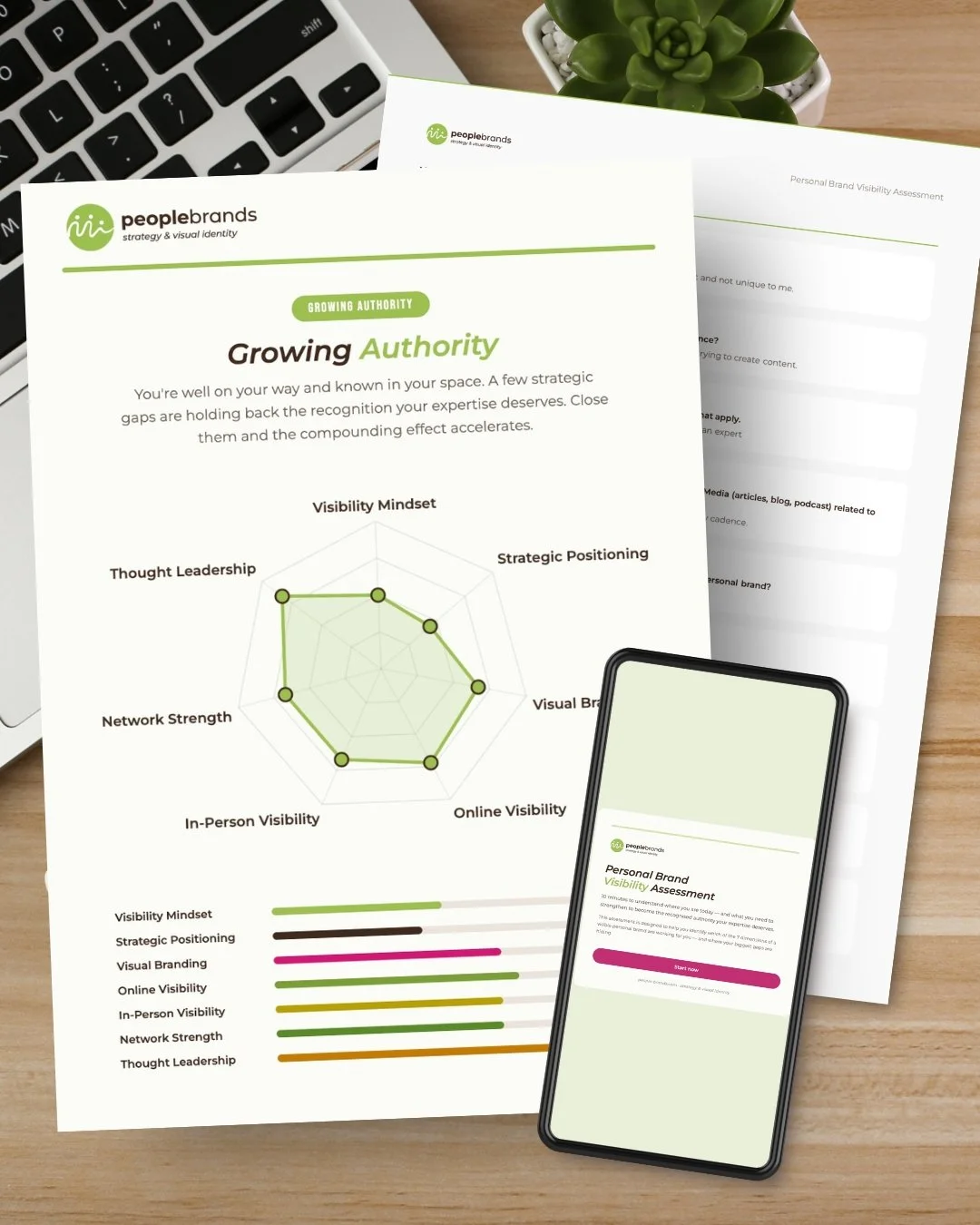
You’ll discover:
Visibility Mindset — Are you genuinely ready to be seen, or is imposter syndrome keeping you small?
Strategic Positioning strength — Is your differentiation clear and memorable?
Visual Brand impact — Does your visual presence build or undermine credibility?
Thought Leadership progress — How far along are you on the path to being the recognized authority in your field?
Online Visibility — Is your digital footprint working for you or against you?
In-Person Visibility — Are you showing up where decision-makers gather?
Network Strength — Are your relationships opening doors or containing you?
The gap between expert and recognized authority isn’t knowledge. It’s strategic visibility across all seven dimensions.
Close the gaps. Claim the recognition your expertise deserves.
Frequently Asked Questions
Q: What are the dimensions of a personal brand?
A: A visible personal brand is built across 7 dimensions: Visibility Mindset, Strategic Positioning, Visual Branding, Thought Leadership, Online Visibility, In-Person Visibility, and Network Strength.
Q: Do I need to be famous to have a strong personal brand?
A: No. A personal brand doesn’t need to make you famous it needs to make you well known within your area of influence. That could mean 500 decision-makers in a specific niche or a global platform. Both are powerful personal brands. The 7 dimensions apply at any scale.
Q: What is personal brand visibility?
A: Personal brand visibility is the degree to which the right people your ideal clients, collaborators, media contacts, and decision-makers can find you, understand your expertise, and recognize you as an authority. It combines online presence, in-person presence, visual branding, thought leadership, network, and positioning working together.
Q: What is the difference between content and thought leadership?
A: Content is anything you publish. Thought leadership is the development and sharing of your own intellectual property original frameworks, methodologies, and perspectives that are uniquely yours. Content can be replicated. Your IP cannot. Thought leadership is what makes you the source others reference rather than one of many voices in the feed.
Q: How do I improve my personal brand as an established expert?
A: Start with an honest assessment of all 7 dimensions: where are you strong, and where are you nearly invisible? Most established experts find they’re investing in 1-2 dimensions while neglecting others. The Personal Brand Visibility Scorecard atpeoplebrands.involve.me/scorecard gives you that clarity in 10 minutes.

About Blanca
I'm a Personal Brand Strategist and TEDx Speaker helping accomplished experts become the go-to authority in their field.
You've already built the expertise. I bring the strategic positioning and visual identity to make sure the right people see it.
With 10+ years in corporate (Siemens, Nestlé, Gates Foundation) and a Master's in Marketing, I understand both the corporate world and the journey of building a business around your expertise. That's what makes my approach different.
I speak on Personal Branding, Visual Identity, Thought Leadership in the AI Era, Entrepreneurship as an Expat, and The Power of Reinvention.
Ready to become the go-to authority in your field?