Blog 90: Why Posting on LinkedIn Isn't Making You a Thought Leader (And What Actually Does)
I often get asked… Should I be posting on LinkedIn? What should I even be posting about?
And every time, I hear the same thing underneath the question.
It's not really about LinkedIn. It’s about visibility, credibility and trust. It is about being seen as the authority in your field.
The problem behind the posting… It's that there's no strategy behind.
Posting on LinkedIn is not the same as being seen as a Thought Leader.
Thought leadership isn't the content you publish. It's the intellectual property you build. LinkedIn is where that IP gets seen. It's not where it gets made.
Confuse the two, and you can post for years and still not be seen as an authority.
What Is the Difference Between Content and Thought Leadership?
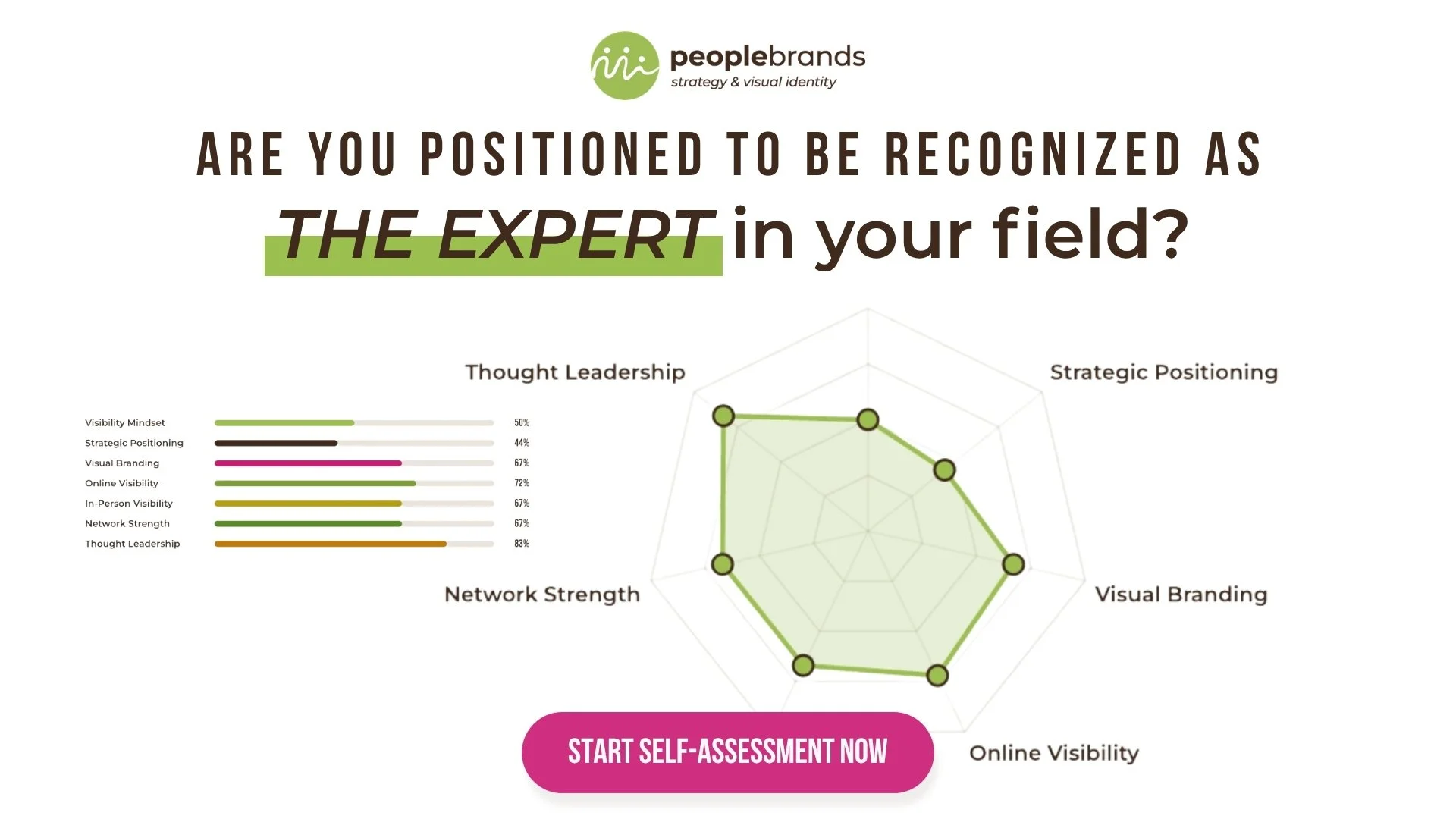
In the peoplebrands Visibility Ecosystem, the framework I use with every client, Thought Leadership is one of seven dimensions. It's one of the three that make up the foundation of the personal brand... alongside Strategic Positioning and Visual Branding of the Future.
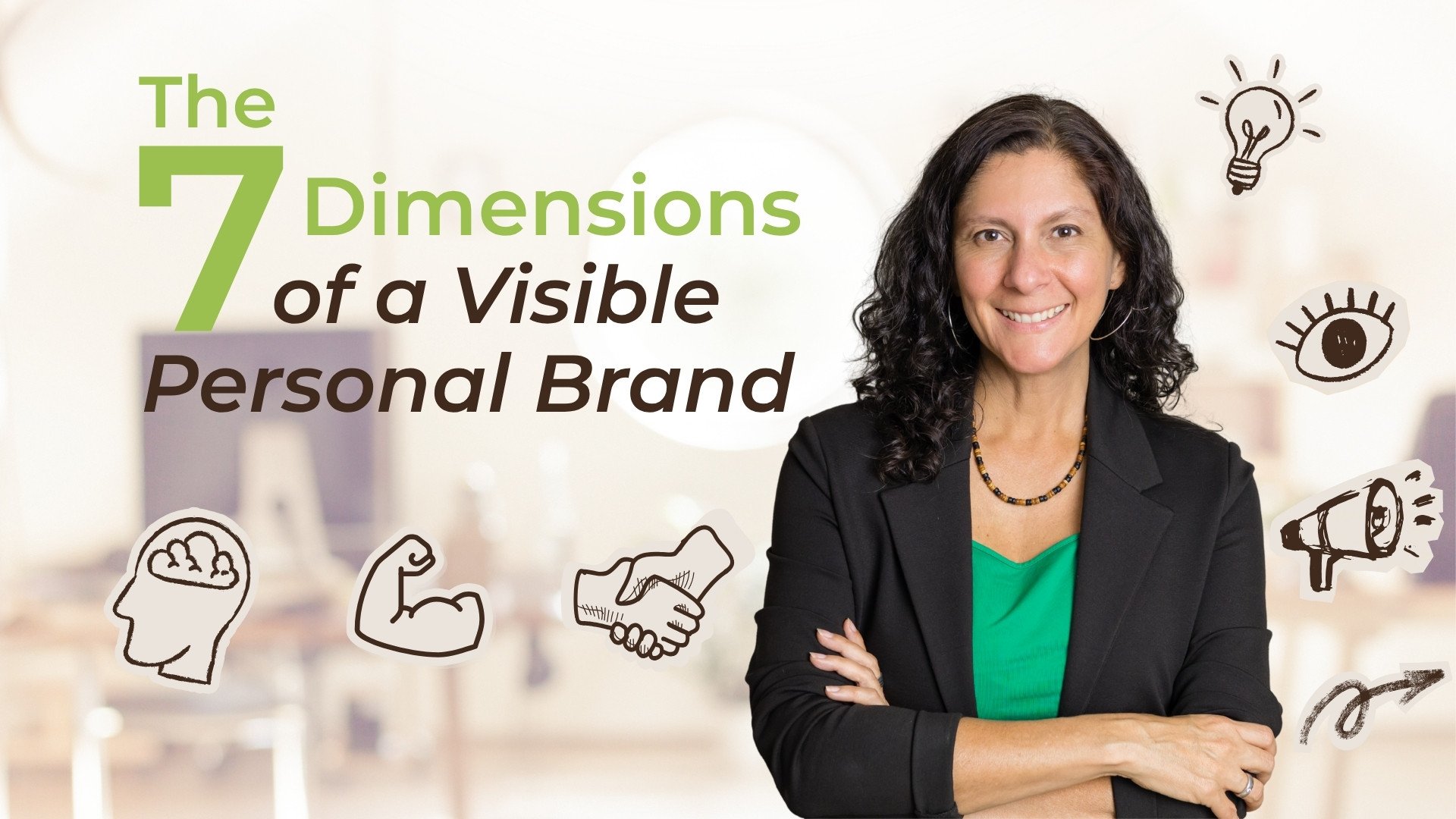
You can watch the video where I explain it.
And here's where I want you to really understand this, because this is the part almost everyone gets wrong.
Thought leadership is not content.
Content is anything you publish. A post. A comment. A carousel your assistant made from a template.
Thought leadership is something else entirely... it's the development and publication of ideas that are actually yours. Frameworks. Perspectives. A way of seeing a problem that only you, with your specific 20+ years, could have built.
Daniel Priestley, in his book Key Person of Influence, lays out a five-step method for becoming a recognized authority: Pitch, Publish, Productise, Profile, Partnerships. "Publish" is the step that matters here, and he's specific about what it means. It's not posting. It's developing and putting out original material, structured thinking that's uniquely yours, that can scale beyond your own time and presence in a room.
Oana Leonte, formerly of Disney, Warner Bros., and PUMA, and founder of unmtchd., puts it even more bluntly. Her own words: "Attention is rented. Meaning is owned." On her site, she goes further: "AI has made attention infinite and content free. Both used to be brand moats. Neither is anymore." Content is not IP. The brands, and the people, who scale to lasting influence are the ones who own something, not the ones who show up the most.
That's the distinction I want you sitting with before you read another word of this.
Because here's what it looks like in practice, on the same platform, side by side.
One expert posts: "5 tips for better client communication." Useful. True. Forgettable. It could have been written by anyone and probably it has been written thousands of times over.
Now, something like this: "I stopped assuming client briefs were what my clients really needed in 2019, after a project failed for a reason nobody could have caught by asking the standard questions. Here's the three-question filter I created instead, and why the standard discovery call doesn’t work for complex projects." This post doesn’t read anything like the previous one.
The first is content. The second is thought leadership, because nobody else could have written it. It came from a specific failure, a specific fix, and a specific point of view that only she has earned the right to hold.
You get the idea…
Why Posting on LinkedIn Won't necessarily Build Real Authority?
Here's what I want to be honest with you about.
This kind of content will probably never go viral.
It's not designed to. It's not built for the algorithm, it's built for the handful of people in the room who matter... the decision makers.
Thought leadership is not about being seen by everyone.
It's about being unmistakably credible to the right ones.
And credibility... real, durable credibility... is not built through virality. It's built through repetition of a clear point of view, over time, until people start recognizing you.
I think about it like this. Visibility gets you noticed. Thought leadership gets you trusted. And trust is what actually converts into the premium client, the speaking invitation, the board seat.
Now more than ever, being able to be seen as an authority and to develop your Thought Leadership know-how is relevant. AI has made content nearly free to produce, we all have the same tools. Anyone can generate a polished, well-structured post about your topic in thirty seconds.
Which means content, by itself, has stopped being a signal of differentiation. It has become a commodity. Poor content, generic content can do more damage to your reputation than you think.
What can't be generated is the specific failure that taught you something. The client you almost lost, and the reason why you didn't. The belief you hold about your field that would get you grilled at a conference, because you're not just repeating consensus.
True expertise and lived experience is the only thing left that actually differentiates one expert from another in a feed full of content that all sounds vaguely the same.
You already know this, if I'm honest. You didn't build 20 years of expertise by chasing attention, rather by doing the work that needed to be done, through trial and error, success and failure, because each of those times you failed, you built knowledge and perspective that are your own.
Is LinkedIn the Right Place to Build a Personal Brand?
I want to say something that might sound strange coming from someone who spends this much time talking about LinkedIn.
LinkedIn is a place for distribution. That's it.
It is not where thought leadership is built. It's where it gets seen, once it already exists.
The actual work happens somewhere else entirely, in your mind. The experience built through your frameworks, the methodologies you've tested on real clients and refined because the first version didn't quite work. The lessons you've earned the hard way, that nobody handed you in a book.
Here's the mindset change that I ask every client to make.
Stop asking yourself "what should I post about?"
Start asking "what have I built that nobody else has?", “what do I know that has a different perspective?”
That's where the content comes from. Not the other way around.
And when you write about it... teach it. The what. The why. Rarely the how, and if you do share a how, keep it at the level of a principle, not a step-by-step.
People learn to trust you not because of the checklist you gave them. They build trust in you because of your perspective, your lived experience, the way you got to where you are, made them think differently about something they thought they already understood.
Your potential customer doesn't want your tutorial. They want to know how you actually did it. They want your guidance. They want you to help them do it the way you did.
If I have learned one thing, is that where most people fail is in the implementation, you can share the perspective, people who really want to make things happen will come back to you for help on getting it done.
What This Looked Like For Me
Here's how this actually showed up in my own work.
For years, people came to me for business photos. They wanted images for their website, for their profile, for their marketing.
But the more I worked with people, the more I realized the problem was much deeper than having “nice” images.
They had no branding. No clear company values. They didn't know what they actually wanted to communicate through those images. They had no clear idea of their positioning, and honestly, a lot of the time, no clear idea of who their ideal customer even was. Some of it was there, but blurry. Undefined.
So they needed the photos, sure. But the photos were never really the problem.
That's how my program S.H.I.N.E. was born. As a way to help people develop the strategic understanding first, the visuals second, and the narrative they needed to actually reach the right customer, all working together.
And it kept growing into something bigger, because I realized most of the people coming to me didn't actually need "visibility" for its own sake or as an end goal.
What they needed was Authority, Trust & Credibility in a digital space.
Visibility was just the vehicle. The real destination was being recognized as a trusted authority.
That's exactly why the peoplebrands Visibility Ecosystem exists as seven dimensions. Photos alone don't build trust. Posting alone doesn't build trust. It's positioning, visual identity, and thought leadership, working together, that does.
How Do You Build Credibility Through Personal Branding on LinkedIn?
Once you have the Strategic Foundation of your Personal Brand (for example working with me in my S.H.I.N.E. Program)... LinkedIn becomes genuinely useful as a tool to distribute and communicate as a credibility engine.
A few things I have every client work through in their LinkedIn Profile to make sure it communicates authority and professionalism:
Clear positioning, be concise. On your banner, on your headline and your "about" section should tell a stranger exactly what you're known for, in one read. Not generic like: "I help businesses grow." If your positioning is vague, your best thought leadership post still lands as noise, because the reader has no category to file you under.
A bio that communicates expertise, know-how. Specific outcomes. Specific numbers. "20 years in leadership consulting" tells me nothing. "Helped 40+ mid-market CEOs restructure their executive teams during acquisitions" tells me exactly what room you belong in. Vague job titles from a decade ago do nothing for you. Precision does.
Recommendations, actually asked for. Ask the people you've worked with to speak to the specific transformation you created for them, not just "great to work with." That's third-party proof, remember that for a stranger reading your profile it inspires trust if it is someone else's account shared publicly.
Articles and posts that carry your actual thinking. This is where the IP shows up publicly. Not "5 tips." Share your experience, your methodology, reframe a problem everyone in your industry keeps getting wrong, tell us where you think the industry is going, what we should be watching for. And this is also where consistency compounds: one strong post is a data point, a body of them, over months, becomes a reputation.
A visual identity that matches the level of what you're saying. This is the one people underestimate most. Your banner, your profile photo, the way your posts and documents look, all of it either supports your credibility or quietly undercuts it before anyone reads a word. I've seen experts publish genuinely sharp thinking underneath a profile photo from a decade-old conference badge. The words said "authority." The visuals said "I haven't updated this in years." People notice the mismatch, even when they can't name what felt off.
Do these five things well, and LinkedIn stops being a place you shout into. It becomes the place where your credibility compounds, quietly, whether or not any single post goes anywhere near viral.
Do You Need to Go Viral to Be Seen as an Authority?
No. And this is worth being precise about, because "visible" and "viral" get treated as the same thing, and they aren't.
Think about the difference between someone like Gary Vaynerchuk or Mel Robbins, and someone like Dr. Eric Topol.
Vaynerchuk and Robbins are widely known. Their audiences span industries, countries, age groups. That reach is exactly what their business models need, because they're building at a scale where broad recognition is the point.
Eric Topol is a cardiologist and geneticist, the founder of Scripps Research Translational Institute. He's not a household name outside of medicine, genomics, and healthcare AI. But within that world, he's one of the most cited, most trusted voices there is. People in his field read what he publishes and take it seriously, whether or not it ever reaches a wider audience.
Both are legitimate. Neither is "more correct" than the other.
The real question isn't "should I go viral." It's "what does my business actually need."
If your model depends on volume, on a funnel, on reaching thousands of people who've never heard of you, a wide following and yes, some virality, genuinely matters.
But if your model is five extraordinary clients a year, people who are very exclusive, you don't need a large audience. You need to be the name that gets said in a specific room, by the right person, at the right moment.
Being known and respected within your specific field can exist completely independent of being widely known outside it.
And here's what both versions actually share. The more in-demand you are, at whatever scale that means for you, the more you get to choose who you work with. That's the real payoff. Not the reach itself.
How Does Thought Leadership Fit Into a Personal Branding Strategy?
I don't want to turn this into a LinkedIn masterclass.
What I want you to walk away with is this.
Thought leadership is one piece. One dimension, out of seven, in a visibility ecosystem that also includes your strategic positioning, your visual identity, your digital footprint, your in-person presence, your network strength, and whether you're even, honestly, ready to be seen at all.
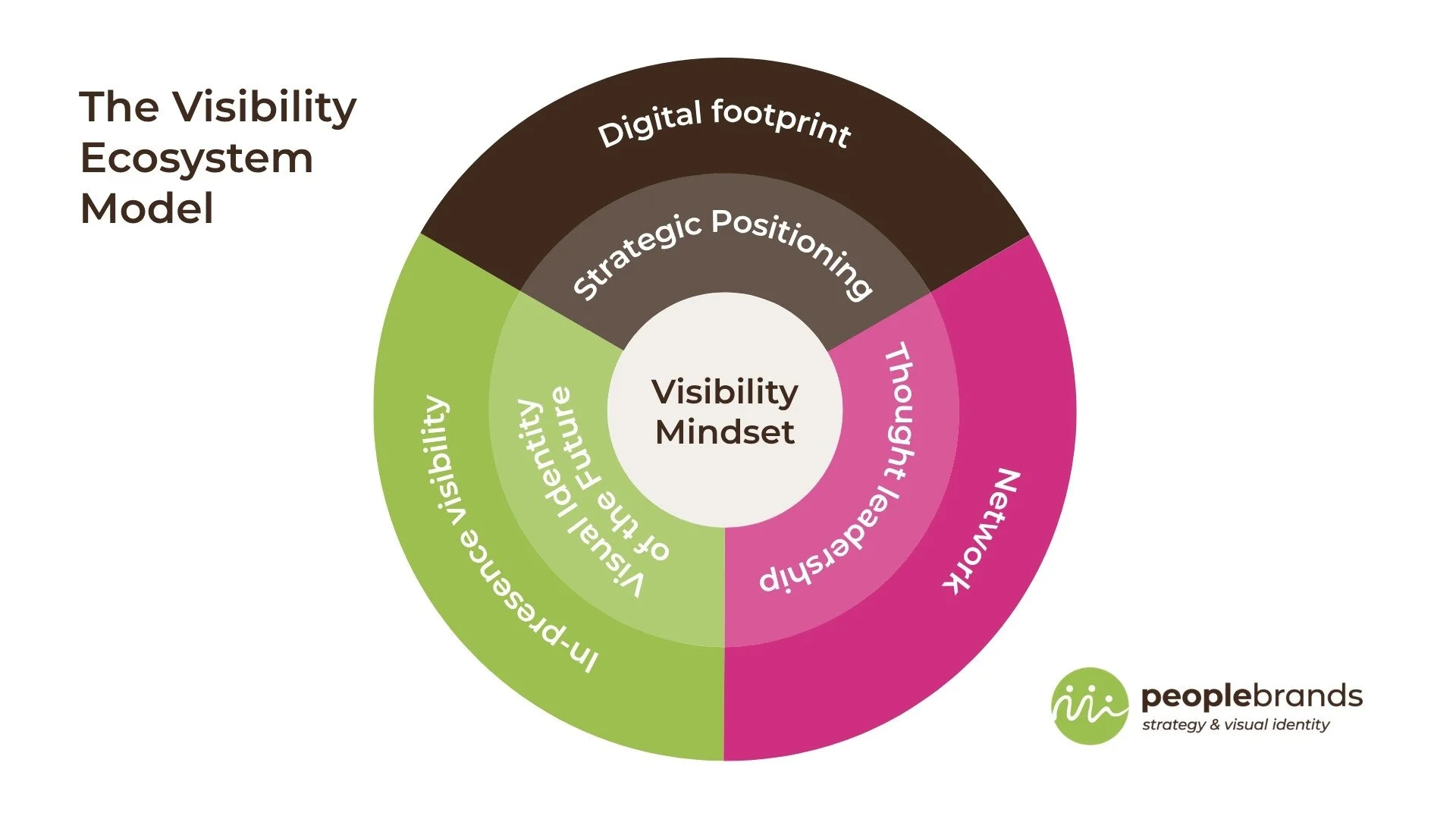
Building thought leadership without strategic foundation, without showing up visually in the role that you want to be seen that aligns with your professionalist, it won't work, no matter how “good” the content is.
But skip thought leadership, and the rest of your visibility has nothing to say. Your positioning tells people what you do. Your visual identity tells people who you are. Thought leadership is what proves you're right about any of it.
Visibility. Credibility. Trust.
That's the order. Visibility gets you found. Thought leadership is what turns being found into being believed. And trust is what turns being believed into being hired, invited, and referred, without you having to ask.
How Do You Know Where Your Personal Brand Actually Stands?
If you've been posting and wondering why it isn't landing the way you hoped, this is worth asking honestly: is it a thought leadership problem, or is it a different dimension entirely that's actually holding you back?
The Personal Brand Visibility Scorecard measures exactly this, across all seven dimensions, including where your thought leadership currently stands and what's likely underneath the disconnect. It takes ten minutes, and it will tell you more about where to focus next than another six months of guessing.
Because posting more of the same thing... isn't a strategy. It's just more noise.
FAQ
Q: Is posting on LinkedIn the same as thought leadership?
A: No. Posting is publishing content. Thought leadership is developing and sharing original intellectual property, your own frameworks and perspective, that only you could have built from your specific experience.
Q: Why doesn't my LinkedIn content get traction even though I post consistently?
A: Consistency alone doesn't build authority. If your posts share general tips or other people's ideas rather than your own point of view, you're contributing to the noise instead of standing apart from it.
Q: Do I need to go viral to be seen as a thought leader?
A: No, and most durable thought leadership isn't viral. Content that goes viral is often contrarian, inflammatory, or built to spark visible disagreement. Thought leadership content is usually the opposite: measured, specific, and not designed to provoke a reaction. The people who actually make hiring and buying decisions are often quietly watching and forming an opinion of you long before they ever like or comment, and they don't engage publicly until they're ready to act. Thought leadership is built through a clear, repeated point of view that earns trust with a specific audience over time, not through reach alone.
Q: What should I actually post about if not tips and how-tos?
A: Focus on the what and the why: your frameworks, your reasoning, your lived experience and how you arrived at your perspective. Save detailed how-tos for paying clients; a generic-level how is fine, a full tutorial isn't thought leadership.
Q: How does thought leadership fit into a personal brand strategy?
A: Thought leadership is one of the seven dimensions in the Visibility Ecosystem. It works alongside strategic positioning, visual identity, digital footprint, in-person visibility, and network strength to build genuine authority, not as a replacement for the others.
Q: Why does thought leadership matter more now that AI can write content for anyone?
A: Because AI has made generic content nearly free to produce, which means content alone no longer signals expertise. What can't be generated is your lived experience: the specific failures, fixes, and beliefs that only someone with your exact path could hold.

About Blanca
I'm a Personal Brand Strategist and TEDx Speaker helping accomplished experts become the go-to authority in their field.
You've already built the expertise. I bring the strategic positioning and visual identity to make sure the right people see it.
With 10+ years in corporate (Siemens, Nestlé, Gates Foundation) and a Master's in Marketing, I understand both the corporate world and the journey of building a business around your expertise. That's what makes my approach different.
I speak on Personal Branding, Visual Identity, Thought Leadership in the AI Era, Entrepreneurship as an Expat, and The Power of Reinvention.
Ready to become the go-to authority in your field?